ec-curve-symmetry-finite-field
Elliptic curves are symmetric over
In secp256k1 over , the curve forms an abelian group where point addition is defined as "draw a straight line through both points and take the inverse of the intersection (the third point)." The graph is symmetric along . There exists a point such that , namely . This point won't lie on secp256k1 if it is taken over , so every point will have a distinct inverse in that case.
Plotting the curve over
We vary and substitute each into . So for each we get , where .
If is a quadratic residue of , then the point lies on the curve. We get two solutions: and . If is even, then is odd. Similarly, if is a QR then is a QNR. If is a quadratic non-residue of , then there is no solution.
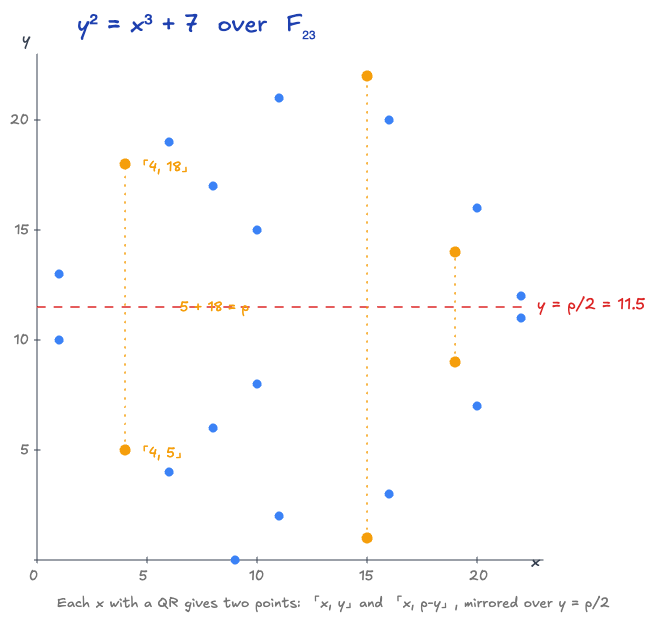
The symmetry axis
The graph is symmetric along because and belong to the same , since .
But wait. is odd, so does not belong to . Should we compute instead? That is always zero. But the EC curve is not symmetric over .
Also, since is odd, the number of quadratic residues and non-residues are not equal. But the -coordinate points on the EC curve seem to be symmetric over anyway.
So the symmetry is visual, not algebraic in . When we plot the points on a standard integer grid, and are equidistant from by construction. The axis is a property of how we draw the graph, not a meaningful element of the field.
Quadratic residues in
Exactly half of are quadratic residues, and they are the even powers of a generator . A group can have different generator points, but the set of QRs can't be different. So the even powers of any result in the same set QR?