lagrange-offset-property
In a -of- Shamir secret sharing scheme, if you add a constant to every share, the reconstructed secret shifts by exactly .
This is the property that makes "agnostic tweaking" work in FROST/ChillDKG — each signer can independently add the tweak to their own share, and the combined signature just works, no coordinator correction needed.
The Math behind it
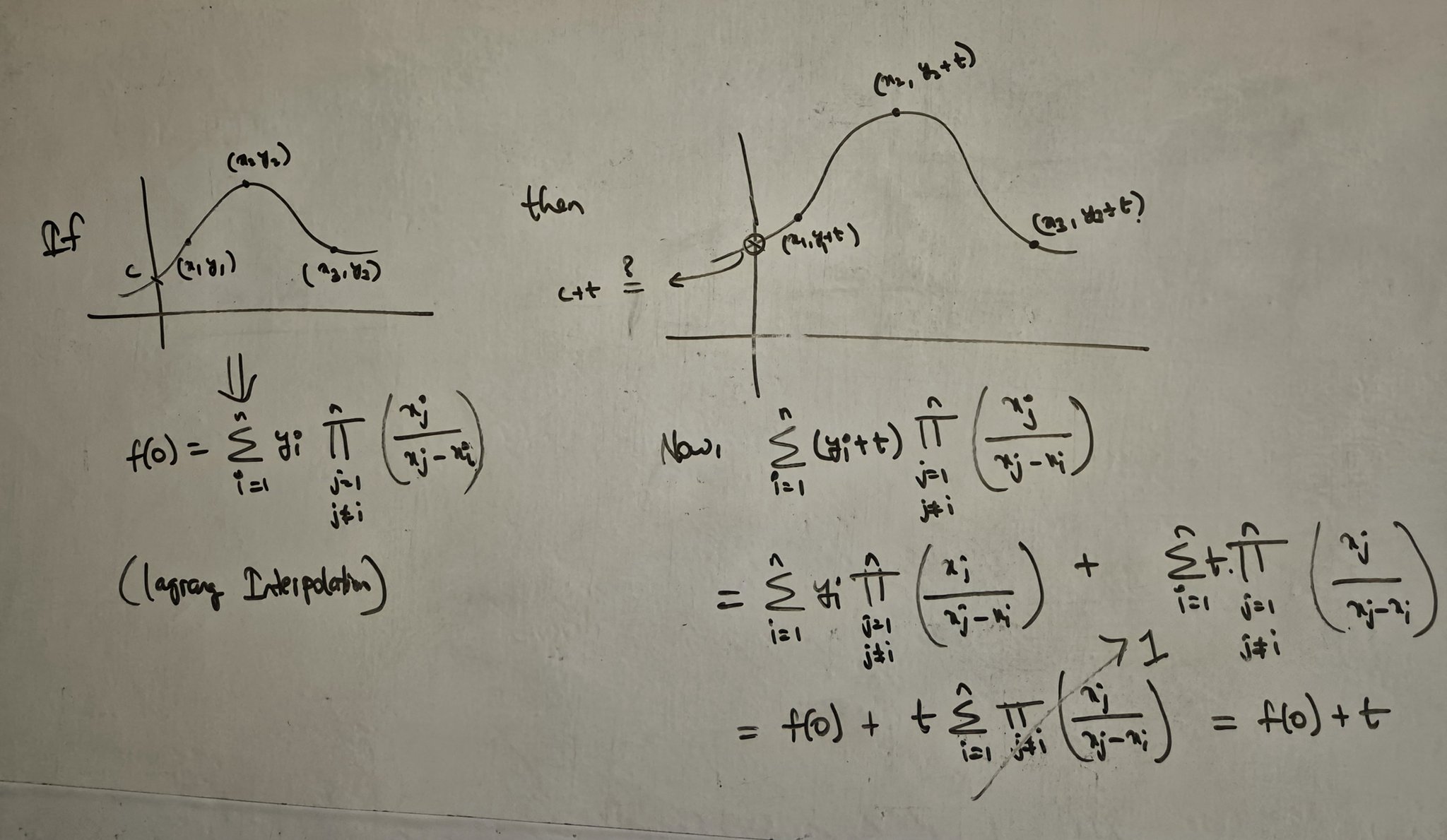
Suppose we have signing participants with secret shares that reconstruct the secret via Lagrange interpolation:
If we offset each share by and reconstruct:
So the whole question reduces to: what's the value of ?
Coefficients sum to 1
Consider the set of points . All y-values are 1, so the unique interpolating polynomial is the constant function . Evaluating at :
The Lagrange basis polynomials are defined so they interpolate any set of y-values. When every y-value is the same constant, the interpolation just returns that constant. That's all this is.
Why this matters for FROST tweaking
In BIP327-style tweaking (used by MuSig2 and current BIP445 draft), the tweak responsibility is split: signers adjust their share by a sign flip gacc, and the coordinator applies a correction e * g * tacc during partial signature aggregation. This couples signing with tweaking.
The offset property enables "agnostic tweaking": each signer adds the full tweak to their own secret share before signing. Since Lagrange coefficients sum to 1, the reconstructed tweaked secret is exactly — no coordinator correction needed. The signing protocol doesn't even know tweaking happened.
Why this doesn't work for MuSig2
MuSig2 uses key aggregation coefficients , not Lagrange coefficients. There's no reason for — the hash function doesn't have this structure. So you can't just add a tweak to each key share and expect the aggregate to shift by the same tweak.