one-to-one-proof-converse-trap
Two statements look almost identical, yet only one proves a function is one-to-one. The definition is : assume the outputs are equal, deduce the inputs were equal. The tempting lookalike just flips it to : different outputs came from different inputs. Both seem to say distinct things stay distinct, so why does the first prove one-to-one and the second prove nothing about it?
Where I got stuck
I read the first statement as the definition and the second as an obvious twin of it. Both talk about two inputs and two outputs staying apart. I could not see why the direction of the implication, which side you assume and which side you conclude, decides whether you have proved one-to-one at all. They felt like the same claim written two ways.
Statement 2 never tests a collision
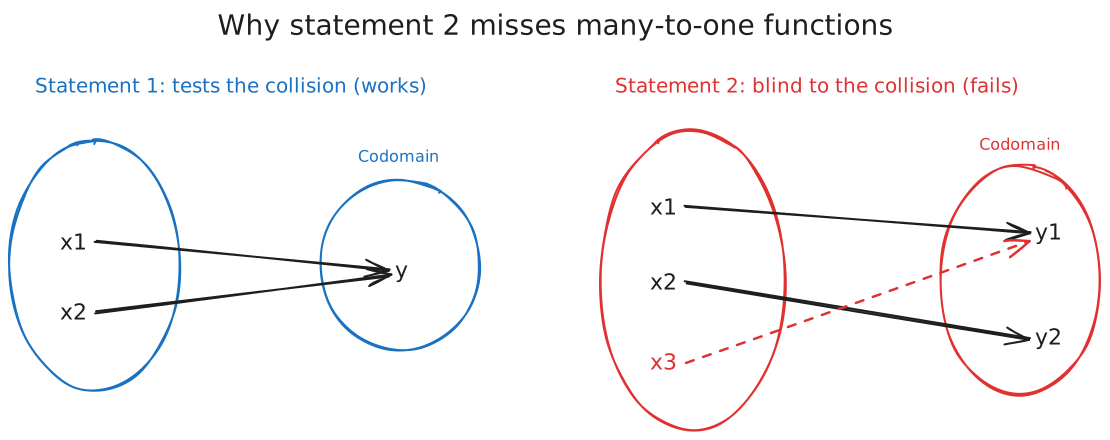
Statement 2 fails because it only ever looks at outputs that are already different, and a one-to-one function breaks at the outputs that are the same.
Picture statement 2 in action. It pairs one input to an output, and a second input to a different output. Both inputs are distinct, both outputs are distinct, the statement is satisfied. But nothing stops a third input from landing on one of those two outputs. That third arrow is a collision, two inputs sharing one output, which is exactly a many-to-one function. Statement 2 never looks there, so a many-to-one function sails right through it.
The definition does the opposite. It starts at a shared output and forces the two inputs to be equal. It walks straight up to the collision and rules it out. That is why it eliminates the whole many-to-one subset and leaves only one-to-one behind.
Take on the reals, which is not one-to-one since . Feed it to statement 2 and pick two different outputs, say and . Their inputs and are different, so the statement holds. It held, and the function is still many-to-one. The collision at , where and meet, sits in a blind spot statement 2 never visits.
Statement 2 is the converse in disguise
Statement 2 is not the contrapositive of the definition. It is the inverse, and the inverse is logically equivalent to the converse, not the original.
One implication between input-equality and output-equality has four forms. Write the definition as the original, and the rest fall out:
| Statement | Logical role | What it proves |
|---|---|---|
| original (statement 1) | one-to-one | |
| contrapositive (statement 3) | one-to-one | |
| converse | just being a function | |
| inverse (statement 2) | just being a function |
The original and its contrapositive are equivalent, so statement 1 and statement 3 both prove one-to-one. The converse and the inverse are equivalent too, and statement 2 is the inverse. So statement 2 says exactly what its converse twin says: , same input gives the same output.
That is not one-to-one. It is just well-definedness, the rule that one input maps to exactly one output, which is what makes a function in the first place. It is the deterministic-output property, and every function obeys it, many-to-one ones included. So it cannot tell one-to-one functions apart from the rest.
The handle Of the four implications, the original and its contrapositive prove one-to-one. The converse and the inverse only prove you have a function at all. Statement 2 is the inverse, so it lives in the wrong half. To actually prove one-to-one, assume the outputs are equal (statement 1) or assume the inputs differ (statement 3).
This is the same deterministic-output rule that blocks an inverse when a function is not one-to-one, the other half of what makes a function bijective. See onto-functions for the onto side of that story.