exponential-survival-first
Where I got stuck
I could work with fine: expectation, variance, all the integrals. What I couldn't grasp was the story stapled to it. "Arrivals", "waiting time", "survival": every explanation started from and draped analogies over it, and none of them said why the function has this exact shape. The formula felt like an arbitrary starting point with metaphors bolted on.
The key move: don't start from the PDF
Start from one assumption instead: events hit at a constant rate , and what happens in one moment is independent of what happens in the next. Then ask the question that needs no distribution theory at all: what is the probability that nothing happens for the whole stretch ?
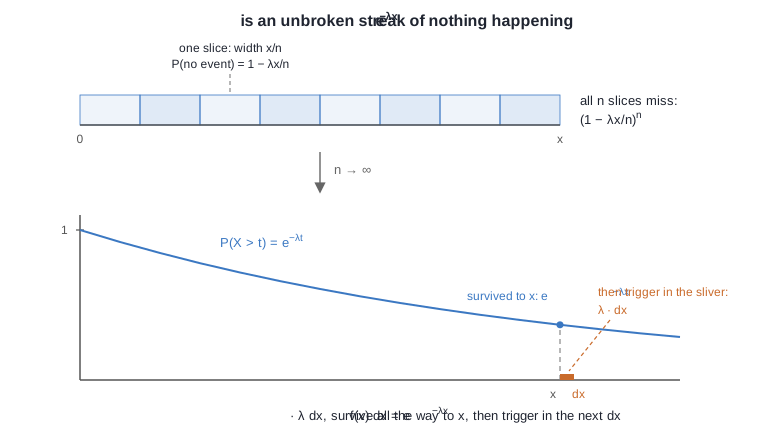
Slice into equal slivers of width . Constant rate means the chance of an event inside one sliver is , so the chance a given sliver stays quiet is . Independence multiplies the slivers, so the whole stretch stays quiet with probability . Finite slices are an approximation. Continuous time is the limit:
by the compound-interest limit with . My first answer to that limit was , which is only the first two terms of the expansion. That is the finite- approximation talking. The limit keeps every term, and infinitely thin slices are exactly where takes over.
So is not a formula to memorize. It is the probability of an unbroken streak of nothing happening, computed directly. The survival function is the primitive object, and I had been trying to read the story off the PDF, which lives two derivatives downstream of where the story actually is.
The CDF and PDF fall out
The CDF is just the complement: , the first arrival landed somewhere in . Differentiate for the density: . Nothing new enters. Both are bookkeeping on the survival function.
Reading f(x)dx literally
The PDF's two factors are the whole story told in one microscopic window:
Survive from 0 to (the streak), then trigger inside the sliver (rate times width). The product is exactly the probability that the first arrival lands in that sliver. Same micro-window reading as pdf-and-cdf-basics, now with the factors carrying the story.
One misread worth pinning: does not say "the first event happens at ". It says at time you are still waiting, the count is still zero. The wait-is-over statement is . With those two straight, reads right too: arrivals at rate 5 per hour means an expected wait of hour.
Survival first. The PDF is survive, then trigger.